Home/Services/SAP Consulting & Integration
SAP ABAP and S/4HANA consulting for Australian businesses
End-to-end SAP technical delivery — from S/4HANA implementation to custom ABAP, interface build and ongoing support. Eight-plus years of hands-on enterprise experience, at contractor rates, on an Australian contract.
The specialism
Enterprise SAP delivery, without the enterprise apparatus
SAP is not a website. It runs your finance, your supply chain and your operations, and a badly built interface does not produce a cosmetic problem — it produces a month-end that does not close and a warehouse that cannot dispatch.
That is why the technical layer needs specialists rather than generalists. Custom ABAP written by someone who has not worked inside a production SAP landscape will run in development and fall over under real volume. An interface built without proper error handling will work perfectly until the day it does not, and then nobody will know why.
We specialise in SAP ABAP development and S/4HANA consulting for mid-to-large Australian businesses. Whether you are running a complex existing environment, planning a migration, or need a specific technical problem solved quickly, we bring the depth of an enterprise consultancy with the responsiveness and pricing of a small independent firm.
From technical design through go-live to post-live support, we manage the full delivery lifecycle — and we document it properly, so that your investment keeps performing long after we have finished.
What we offer
The work, specifically
Six areas of technical SAP work. Most engagements start with one and grow into others as we learn your landscape.
S/4HANA implementation and migration
End-to-end delivery from planning through to go-live, covering greenfield implementations, brownfield conversions and selective data transitions. Includes custom code remediation analysis, SAP Readiness Check assessment, data migration design, cutover planning, hypercare and post-live stabilisation.
Custom ABAP development
Tailored programs and enhancements built inside your SAP system — custom reports, ALV and Fiori-ready outputs, SmartForms and Adobe Forms, BAdIs and user exits, CDS views, complex business logic, data validations and automated background workflows. Written to your naming conventions and documented for whoever inherits it.
Interface design and integration
File exchange, RFC, IDOC, REST, SOAP and OData interfaces between SAP and everything else in your landscape — warehouse systems, MES platforms, banks, CRM, e-commerce and analytics. Built with AIF monitoring, structured error handling and reprocessing logic from day one rather than bolted on after the first outage.
Custom code analysis and remediation
A documented inventory of every custom object in your system: what it does, whether it still runs, whether it survives an S/4HANA conversion, and whether it is worth keeping. Delivered as a remediate, rewrite or retire recommendation per object, using SAP Readiness Check and ABAP Test Cockpit rather than guesswork.
Performance tuning and optimisation
Diagnosis and remediation of slow programs, long-running background jobs and interfaces that cannot keep up with volume. SQL trace and runtime analysis, database access restructuring, parallelisation, buffering strategy. We have delivered peak interface throughput improvements of up to seventy percent on production systems.
AMS support and enhancement delivery
Ongoing application management with defined response times by severity — incident resolution, small enhancement delivery, transport management, proactive interface monitoring and a monthly report on system health and performance trends. Structured so you can scale it up during a program and back down afterwards.
Deliverables
What you actually receive
Every SAP engagement produces the same artefacts, because these are what make the work maintainable after we leave. You own all of them outright.
| Deliverable | What it contains |
|---|---|
| Technical design document | Functional requirement, technical approach, object list, data model, interface contracts, error-handling design and test scenarios. Produced before any code is written and yours to take elsewhere. |
| Custom code inventory | Every object touched or created, with purpose, dependencies, transport numbers and owner. The document your next consultant will thank you for. |
| Unit and integration test evidence | Test cases, execution results and defect log, mapped back to the requirements in the design document. |
| UAT support pack | Test scripts written for business users in business language, plus a defect triage process and a sign-off register. |
| Cutover and rollback plan | Sequenced go-live steps with owners and timings, dependency map, and a documented rollback position at each gate. |
| Runbook and handover | Operational procedures for monitoring, reprocessing and escalation, written for your support team rather than for us. |
| Source code and transports | Full ownership of everything built, in your landscape, under your change control. No licensed components you cannot maintain without us. |
Interfaces
Every integration pattern SAP supports, built and monitored
Interfaces are where SAP projects quietly fail. Not at go-live, but eighteen months later when volumes have tripled and nobody documented the error handling. We build them to be watched, not just to work.
Intermediate documents
Inbound and outbound IDOC processing with custom segment extensions, partner profile configuration, status monitoring and automated reprocessing logic for the failure modes that would otherwise need a human every morning.
Remote function calls
Synchronous and asynchronous RFC interfaces, custom BAPI wrappers, qRFC and tRFC queue management, and the connection handling that keeps a chatty interface from exhausting your work processes.
REST and Fiori services
Custom OData services built on CDS views and the SAP Gateway, consumption by Fiori apps and external systems, entity modelling, deep inserts and the batch handling that keeps a mobile client responsive on a poor connection.
Web services
Enterprise service consumption and provision, WSDL configuration, SOAMANAGER setup, certificate and authentication management, and the retry semantics that stop a transient network fault becoming a missing transaction.
Flat file exchange
Bank statement import, payroll and third-party file processing, fixed-width and delimited parsing, archiving, checksum validation and duplicate detection — the interfaces that look trivial until the file format changes without warning.
Monitoring and error handling
SAP Application Interface Framework configuration so your business users can see, diagnose and reprocess failures themselves. Custom error categories, alert recipients and reprocessing rules — instead of a support ticket every time.
Stack
What we build with
We work inside your existing landscape and toolchain rather than importing our own. This is what we use most.
- SAP S/4HANA
- SAP ECC
- ABAP / ABAP OO
- CDS Views
- SAP Gateway / OData
- SAP BTP
- SAP AIF
- SAP PI / PO
- Integration Suite
- Eclipse / ADT
- ABAP Test Cockpit
- SAP Readiness Check
- SAP Fiori / UI5
- Solution Manager
- Postman
- Jira / Confluence
Why it matters
Three reasons this is worth doing properly
SAP is mission critical. Your SAP environment runs finance, supply chain and operations. A poor implementation or a badly built integration does not degrade gracefully — it stops month-end, blocks dispatch and creates reconciliation work that continues for quarters. The cost of getting the technical layer wrong is almost always larger than the cost of the technical layer.
Australian accountability, global capacity. You contract with an Australian-registered company and get a named Brisbane-based lead who owns the outcome — with a delivery team across five locations behind them. Genuine SAP capability at contractor rates, a shorter procurement cycle and a smaller minimum engagement than a global system integrator will accept.
Performance compounds. Interface optimisation work has produced throughput improvements of up to seventy percent on production systems — which means faster data, fewer errors, less manual reprocessing and lower operating cost every single month afterwards. Unlike most consulting spend, performance work keeps paying.
Questions
SAP Consulting & Integration, answered
What is the difference between a brownfield and a greenfield S/4HANA migration?
A brownfield conversion takes your existing ECC system, with all of its configuration, custom code and history, and converts it in place to S/4HANA. A greenfield implementation builds a new S/4HANA system and migrates only the data you choose to bring. Brownfield is usually faster and cheaper but carries your accumulated technical debt forward; greenfield is a chance to clean up but costs more and takes longer. There is also selective data transition, which sits between the two. Which one is right depends on how much of your custom code is still earning its keep — and a custom code analysis is usually the first thing we run.
Our custom ABAP code is old and nobody understands it. Can you help?
This is one of the most common reasons clients contact us. We run a custom code analysis using SAP Readiness Check and ABAP Test Cockpit to establish what exists, what is actually being executed, what will break under S/4HANA, and what can safely be retired. Very often a significant share of custom objects have not run in years. You get a documented inventory with a remediate, rewrite or retire recommendation against each object.
Can you work alongside our existing SAP partner?
Yes, and we do it regularly. Some clients keep a large SI for functional configuration and bring us in for technical development and interface work, where a specialist is faster and considerably cheaper. We work inside your existing transport landscape, change control and governance processes rather than asking you to change them for us.
How do you handle transports and change control?
We follow your process. If you have a formal three-system landscape with a change advisory board, we work within it and produce the documentation your CAB expects. If your process is informal, we will tell you honestly where the risk sits, but we will not hold your project hostage to a governance overhaul you did not ask for. Access for any team member outside Australia is arranged under your own security and data-residency rules, agreed in writing before work starts.
What does the 70% performance improvement refer to?
That figure comes from an interface optimisation on a production system, where restructuring the ABAP logic and database access reduced peak processing time by roughly seventy percent. It is a real result from a specific engagement, not an average. Performance gains depend entirely on how the existing code is written — sometimes the win is enormous, sometimes the code is already efficient and the bottleneck is elsewhere. We tell you which before you commit to the work.
Do you offer ongoing support after go-live?
Yes, through an AMS agreement with defined response times by severity. That typically covers incident resolution, small enhancement delivery, monitoring, and a monthly review of interface health and performance trends. Because our delivery team spans several timezones, extended-hours coverage is available where your agreement calls for it. AMS is optional — plenty of clients take the handover pack and run it internally, which is a perfectly good outcome.
Next step
Have a specific SAP problem? Start with a conversation, not a proposal.
Bring us a slow interface, an unmaintainable custom program, or a migration you are not sure how to approach. Forty-five minutes, no charge, and a straight technical opinion at the end of it.
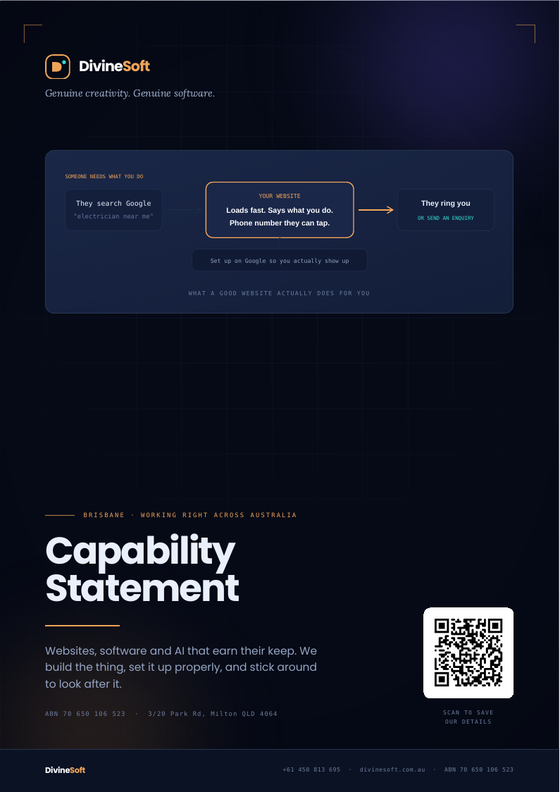
Download our capability statement
Ten pages covering what we do, what it costs, how we work and who we work with. Handy if you need to show someone else, or you would rather read it later.